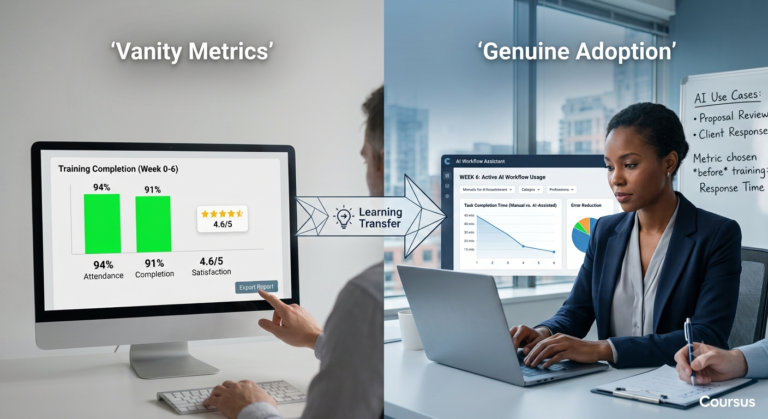

Your people may be using AI, and individual tasks might be moving faster. But guess what? Usage alone doesn’t guarantee bottom-line ROI. The real distinction lies in what AI high performers do differently to convert scattered daily adoption into measurable financial value
McKinsey’s 2026 global survey offers a useful comparison. Just 6% of respondents meet its definition of an AI high performer: an organisation attributing at least 5% of EBIT to AI and describing the value as significant. That share has not moved since 2025. The interesting part is not the 6%. It is what those organisations do differently, because McKinsey now has enough data to compare their practices directly against everyone else’s.
The encouraging part is that almost nothing on their list is exotic. There is no proprietary model, no unavailable technology and no secret vendor. The list is dominated by organisational decisions rather than proprietary technology.
What this article covers
This article sets out what separates AI high performers across seven areas: workflow, ambition, leadership, measurement, human oversight, risk and cost. It ends with a way to start closing the gap inside one quarter. If you have not yet checked whether your AI investment is changing how people work, read that first. This article assumes you already know the answer is no.
HOW HIGH PERFORMERS ARE DEFINED McKinsey’s threshold is specific and financial: at least 5% of EBIT attributed to AI use, plus a self-reported description of the value as significant. In the 2026 sample this was 92 respondents out of 1,719. Small groups make for noisier data, so treat the ratios below as strong directional signals rather than precise coefficients.
Who the AI high performers are, and how they are counted
Start with what the 6% figure does not mean. It is not a claim that 94% of AI programmes have failed. It is the share of respondents clearing a deliberately demanding bar: a measurable, attributable EBIT contribution of 5% or more. Plenty of organisations below that line are seeing genuine value they simply cannot attribute that precisely. Plenty more have not been deploying long enough for a financial signal to appear.
It is also self-reported, from a survey of 1,719 people across 97 countries, weighted by each nation’s contribution to global GDP. Nobody audited these accounts.
What separates AI high performers
With those caveats in place, the comparison is still a useful benchmark, because the gaps are not subtle. Across McKinsey’s practice list, high performers are roughly twice as likely to do most of the things that make AI work. They are about three times as likely to do one of the clearest differentiators.
| Practice | High performers | Everyone else |
|---|---|---|
| Fundamentally redesigned workflows because of AI | Nearly three-quarters | About one-quarter |
| Senior leaders demonstrate real ownership of AI initiatives | About twice as likely | Baseline |
| Defined processes to quantify the impact of AI initiatives | About twice as likely | Baseline |
| Intend to use AI to fundamentally transform the business within 3 years | 3.3 times more likely | Baseline |
| Scaling AI agents in most business functions | Three times more likely | Baseline |
| Spending more than 15% of ICT budget on AI | More than twice as likely | Baseline |
Notice what is absent from that list. There is no row for model choice, vendor selection, or having an AI centre of excellence with a good name. The differentiators are all about how the organisation decided to change itself.
They redesign the workflow instead of inserting AI into it
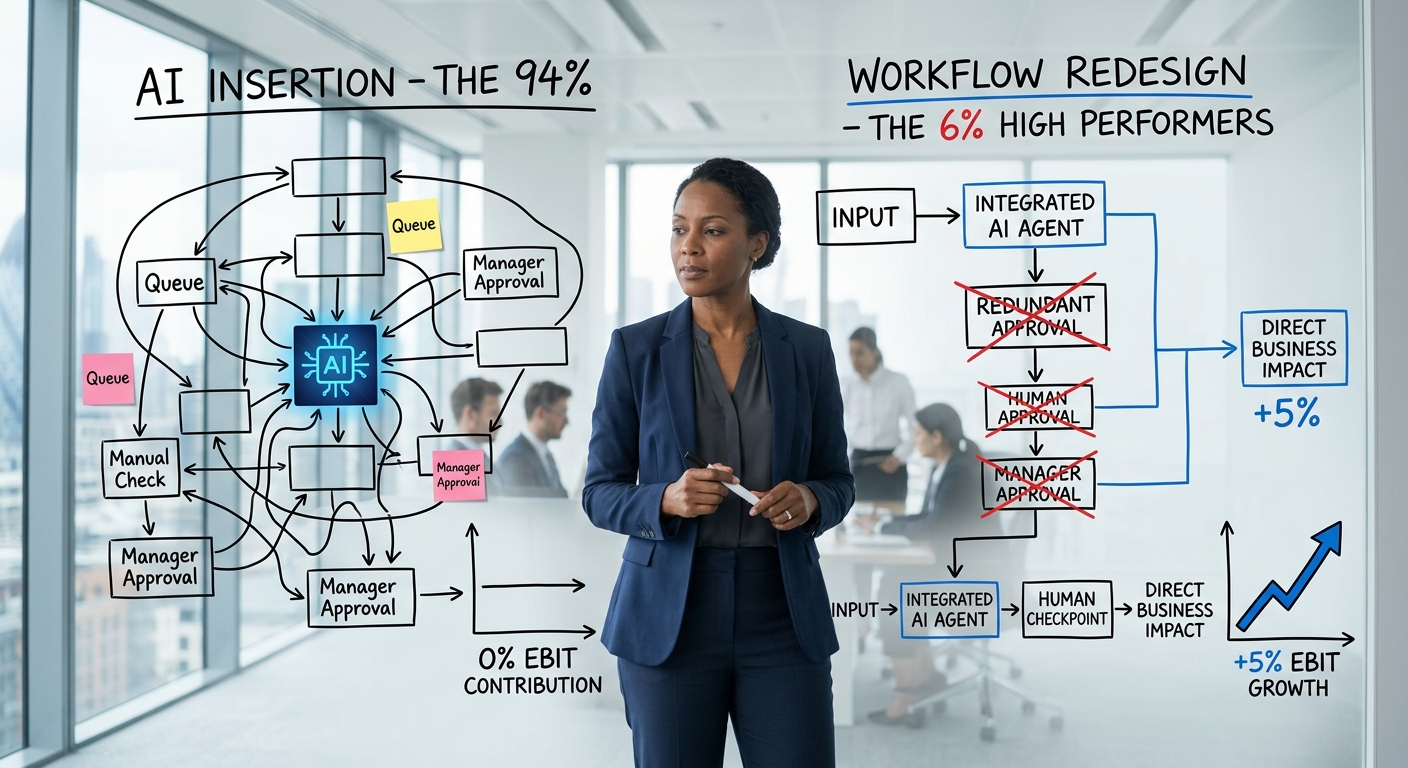
This is the headline finding, and it deserves to be stated plainly. Nearly three-quarters of AI high performers report fundamentally redesigning workflows because of their AI use. That is up sharply from just over half a year earlier. Among all other respondents, roughly one in four say the same.
It is one of the clearest differences in McKinsey’s comparison. It is also a choice, not a capability. Redesigning a workflow requires an owner with authority, a willingness to remove steps, and tolerance for a few weeks of disruption. It does not require a better model.
Bain’s research explains why simply inserting AI fails so reliably. Their term is workflow debt: the unnecessary work that builds up over years around meetings, approvals, policies and handoffs. Automating a process that still carries that debt does not clear it. It locks the debt in, runs it faster, and makes it considerably more expensive to unpick later. Bain’s recommended discipline is to ask what the process would look like if you designed it from scratch today, and only then to ask where AI fits.
Insertion versus redesign
The practical distinction looks like this:
| Inserting AI | Redesigning around AI |
|---|---|
| Same steps, one of them faster | Steps removed before anything is automated |
| Same approvals and handoffs | Approval thresholds revisited and reduced |
| Same roles, informally stretched | Roles rewritten with new responsibilities |
| Review added at the end | Review designed in at defined checkpoints |
| Gross time saving reported | Net outcome measured against a baseline |
| Reversible in an afternoon | Reversing it would be a project |
That last row is the quickest test available. If removing the tool tomorrow would return the team to normal within an hour, no redesign has happened. That is exactly what an AI productivity audit is built to catch.
They aim at growth, not only at cost
Roughly 80% of all organisations, high performers included, say they are pursuing efficiency gains from AI. Efficiency is not the differentiator. What distinguishes the top group is that most of them are pursuing growth and innovation as well. They increase revenue through better targeting or new product features, and create new businesses or business models, while other respondents are markedly less likely to hold those ambitions at all.
High performers are also 3.3 times more likely than others to intend to use AI to fundamentally transform their business within three years. Ambition changes the shape of the programme. A cost-reduction objective tends to focus attention on efficiency within existing operations. A growth or innovation objective forces the organisation to consider where AI can change products, customer acquisition, service delivery or the business model itself.
There is a warning here for finance leaders. Bain found that only a small fraction of companies achieved AI-related savings above 30%, while the most common target was 11 to 20% and the largest group of measurers landed at 10% or below. So an investment case built purely on a cost number starts from an assumption the evidence does not support. A case that also carries a revenue or quality objective has somewhere else to land when the savings arrive smaller than forecast.
KEY DISTINCTION Efficiency is what everybody wants from AI. Growth is what the 6% also wanted, and that is why their programmes were structured differently from the first budget meeting onward.

Leadership owns it, and so does every line manager
High performers are about twice as likely as everyone else to say their senior leaders demonstrate genuine ownership of AI initiatives. That means championing them over time, modelling use personally, and keeping them funded through budget reprioritisation rather than letting them be quietly defunded at the second review.
What executive accountability actually buys
KPMG’s June 2026 Global AI Pulse, based on more than 2,100 senior leaders across 20 countries, sharpens this into something specific. Where accountability for AI-informed decisions sits explicitly with the CEO, organisations report much higher confidence in their AI strategy: 60% against 22%. They are far more likely to report meaningful business value: 57% against 21%. And they are more than three times as likely to have established a measurable return: 14% against 4%. The variable is not enthusiasm. It is named accountability at the top.
Bain reaches the same place from a different direction. The companies realising their savings are the ones treating data access, governance and process redesign as CEO-level problems rather than delegating them to IT.
But executive ownership alone does not reach the desk. Gallup’s 2026 workplace research found a strong association between manager support and whether employees feel AI has transformed how work gets done. Among US employees in organisations implementing AI, those who strongly agree their manager supports their team’s use of AI are 8.7 times as likely to strongly agree that AI has transformed how work gets done. Fewer than one in three strongly agree that their manager actively does so. The finding suggests that executive sponsorship alone is not enough. The manager is part of the implementation layer.
So the leadership requirement is two-sided, and most organisations resource only the top half:
- At the top: a named executive accountable for the outcome, not the tool; funding that survives reprioritisation; visible personal use.
- In the middle: managers who understand the redesigned workflow well enough to coach it, who have adjusted their team’s targets to match, and who are measured on whether the change stuck.
They can prove impact because they built the measurement first
High performers are roughly twice as likely to report having defined processes for quantifying the impact of their AI initiatives. This sounds like administrative hygiene. It is closer to a precondition, because an organisation that cannot measure an outcome cannot decide to scale it, cannot decide to stop, and cannot defend the next budget request.
The scarcity of this capability is remarkable. The same KPMG Pulse found that only 7% of organisations reported having established a measurable return on their AI investments, while nearly a quarter reported rising investor pressure to demonstrate exactly that. It also found that leaders with strong visibility into AI costs were around five times more likely to achieve a demonstrable return than those without.
KPMG’s 2026 Global AI in Finance study, based on 1,013 senior finance leaders across 20 countries and 13 sectors, adds a further finding. Organisations able to produce AI-related audit evidence efficiently reported three to six times the rate of significant improvement compared with those that could not: 33% against 6% on error reduction, and 42% against 14% on confidence in scaling. Assurance readiness turned out to be a stronger predictor of performance than KPI tracking alone. Being able to explain how an AI-assisted decision was reached is not a compliance tax. It is what makes the result trustworthy enough to build on.
What high performers actually do
What this looks like in practice is unglamorous and entirely learnable:
- A baseline captured before deployment, not reconstructed afterwards.
- One primary business outcome, two operational measures, one quality or risk guardrail, one people measure.
- A named owner for every metric.
- A pilot compared against a baseline period or a comparison group.
- An audit trail showing what the system did and who checked it.
- A scheduled decision point: scale, redesign, or stop, with stopping treated as a legitimate outcome.
They design the human in the loop on purpose
One practice that distinguishes high performers is that they have explicitly decided how and when model outputs require a human: validation to check accuracy, escalation when confidence is low, and sign-off before anything consequential leaves the building.
The contrast with the average is stark. Bain found that only a small minority of companies run fully autonomous agents, while the most common production configuration still requires human approval. Bain found a gap between many investment cases, which assume full-automation economics, and the human oversight still present in production. That mismatch explains a great deal of the gap between targeted and realised savings, and no amount of extra budget corrects it.
High performers avoid that trap in both directions. They do not assume autonomy they do not have, and they do not review everything without discrimination either. Reviewing everything is how the rework tax gets paid twice. Instead the design specifies:
- which decisions a human must always make;
- which outputs require verification against a named source;
- what the reviewer is actually checking for, and what they may safely skip;
- the confidence or value threshold that triggers escalation;
- who owns the output once it leaves the workflow.
Notice that every one of those is a capability question as much as a process question. A reviewer who has not been taught what a good verification looks like in their own domain will either wave things through or check everything. Both failures cost the same amount.
They treat risk and cost as design constraints
High performers work to mitigate a broader range of AI risks than their peers. They are notably more likely to be addressing the risks that come with capability rather than novelty: AI-driven exploitation of technical vulnerabilities, and unauthorised or unintended actions by systems acting on their behalf. Those are the risks of an organisation actually deploying something consequential.
Cost shows a similarly telling pattern. About one in five organisations overall report that AI operating costs, including token consumption, have constrained their use. Among high performers, constraint shows up about three times as often specifically on software coding agents: 18% against 6%. Read that as a symptom of intensity rather than mismanagement. They hit the cost ceiling because they are running these systems hard on real work. They are also more than twice as likely to spend above 15% of their ICT budget on AI, and more than half expect to increase AI investment by 10% or more in the coming year, against roughly a third of everyone else.
The lesson is not “spend more.” Bain’s evidence is that larger budgets do not rescue an unvalidated investment case. The lesson is that high performers treat operating cost as a design constraint from the outset. It is something to be engineered around with model selection, token budgets, caching and scope limits, not a surprise that arrives with the third invoice.
How to close the gap in one quarter
None of the seven differentiators requires you to become a technology company. They require a workflow, an owner, a baseline and capable people. Here is a sequence that fits a single quarter.
Week 1: start with the audit. Before you redesign anything, run an AI productivity audit on one workflow to find out where your current AI usage is actually going. You cannot close a gap you have not measured.
Weeks 1 to 2: pick the ground. Choose one high-volume, high-friction workflow with a clear owner and a measurable output. Capture the baseline: cycle time, volume, error and rework rate, cost per transaction, customer result. Name the executive accountable for the outcome, not for the tool.
Weeks 3 to 5: redesign before you automate. Map the workflow as it is actually performed rather than as documented. Remove unnecessary steps and approvals first. Only then decide where AI assists, recommends or automates, and specify the human checkpoints precisely.
Building capability and deciding
Weeks 6 to 8: build the capability into the roles. Rewrite the affected role descriptions. Teach the specific workflow, not the tool in general: which reconciliation steps are safe to delegate, what sufficient verification looks like, how to handle confidential inputs. Workday’s 2026 research, commissioned by Workday and conducted by Hanover Research, found that in 89% of organisations fewer than half of roles had been updated to reflect AI capabilities, and that companies reinvest AI gains in further technology more readily than in their people. Doing the opposite is cheap and rare.
Weeks 9 to 12: pilot, measure, decide. Run against the baseline or a comparison group. Report net outcomes, not gross time saved. Then make a real decision, with stopping available as an honest answer.
THE CAPABILITY HALF OF THE EQUATION Workflow redesign fails when the people inside the redesigned workflow have not been taught the new job. Role-specific AI capability built around real workflows is what turns a process diagram into changed work: verification standards, responsible-use rules and measurable outcomes designed for finance, HR, sales, legal, marketing and operations teams specifically. Coursus provides role-specific AI training built around the workflows teams actually run, with programmes designed around practical capability, verification and measurable outcomes.
Frequently asked questions
What are AI high performers?
AI high performers are organisations that attribute at least 5% of their EBIT to their use of AI and describe the value they have seen as significant. The definition comes from McKinsey’s annual global survey on the state of AI, where this group accounted for 6% of the 1,719 respondents in 2026, unchanged from the previous year. The bar is deliberately financial and demanding, so the figure should not be read as a claim that everyone else’s AI programme has failed. Many organisations are seeing real value they cannot yet attribute to that level of precision.
What do AI high performers do differently?
Chiefly, they redesign work rather than accelerating it. Nearly three-quarters report fundamentally redesigning workflows because of AI, against roughly a quarter of other organisations. They are also about twice as likely to have senior leaders genuinely committed to AI initiatives and to have defined processes for measuring impact. They are 3.3 times more likely to intend a fundamental business transformation within three years, and considerably more likely to design human oversight deliberately and manage AI risk and operating cost as explicit constraints.
Do you need a bigger budget to become an AI high performer?
Budget correlates with high performance but does not produce it. High performers are more than twice as likely to spend over 15% of their ICT budget on AI, yet Bain’s 2026 research is clear that additional spending does not rescue an unvalidated investment case. Many organisations are funding their next wave from savings the previous wave never delivered. The differentiating practices are organisational rather than financial: an accountable owner, a redesigned workflow, a pre-deployment baseline and capable people. Those cost attention more than money.
How long does it take to see measurable AI value?
Long enough that most published surveys are still measuring the early part of the curve. It’s also short enough that a single well-chosen workflow can produce evidence within a quarter. The realistic sequence is a baseline in weeks one and two, a redesign and capability build through the middle of the quarter, and a measured pilot by the end of it. Enterprise-level financial impact takes considerably longer and depends on how many workflows you repeat that cycle on. Beware of business cases promising EBIT movement within two quarters.
Why do so few organisations qualify as AI high performers?
Because the difficult parts are organisational and nobody’s job by default. Buying tools has a clear owner in IT. Redesigning a cross-functional workflow, rewriting role descriptions, changing manager targets and building a measurement system with a pre-deployment baseline have no natural home. McKinsey’s own framing is that the limiting factor is increasingly the organisation’s capacity to absorb change rather than the pace of the technology. The 6% figure has stayed flat for a year even as adoption and spending rose, which is exactly what you would expect if the constraint were organisational.
Can African organisations realistically become AI high performers given infrastructure constraints?
Yes, though the operating environment affects how much of the gain is retained. The IMF’s 2026 analysis of AI in Sub-Saharan Africa estimates regional productivity gains of roughly 0.2% over a decade under current conditions. That rises to about 2.1% under a separate, higher-adoption scenario where electricity, connectivity, skills and governance gaps are addressed. The seven practices in this article are organisational levers, although the operating environment still affects how much value an organisation can capture. The practical route is to choose workflows where data and connectivity are already adequate, budget for power and connectivity resilience explicitly rather than treating outages as surprises, and invest in role-specific capability, which is the one input an organisation controls directly.
THE DIFFERENCE IS BUILT, NOT BOUGHT The organisations reporting the strongest AI results are not distinguished by adoption alone. They are redesigning workflows, assigning accountable owners, measuring outcomes against baselines, building human oversight into the process, and developing the capabilities required to work differently. That is the capability problem. Coursus Corporate AI Training builds role-specific AI capability around the workflows your teams actually run, with practical training, verification standards and measurable outcomes.