
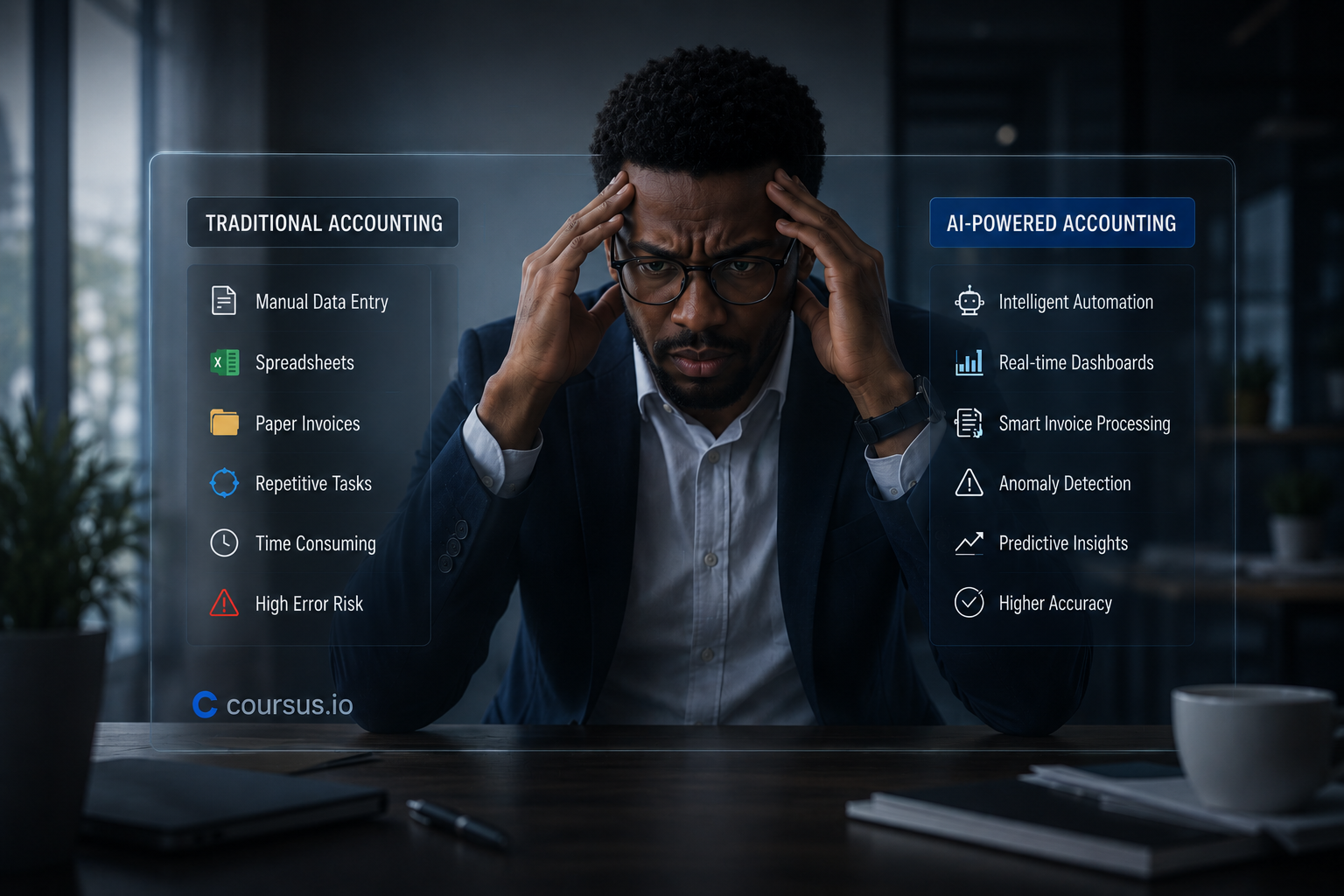

The question of whether AI will replace accountants by 2030 is no longer answered by speculative opinion. Current market tracking indicates that this query represents a fundamental restructuring of corporate back-office human capital lines. Finance professionals who rely exclusively on manual ledger entries, routine reconciliations, and transactional auditing face critical structural displacement within the next four years.
Practitioners who pivot toward technical orchestration, system design, and strategic advisory are securing record-high compensation packages in the global marketplace. Surviving this transition requires a clear understanding of what algorithm platforms can execute and what human professionals must defend.
Corporate operational architectures are replacing legacy accounting software with autonomous AI agents capable of processing thousands of invoices per second. This shift changes the baseline expectations of employers, chief financial officers, and institutional audit clients worldwide. This analytical guide presents an empirical look at the structural limits of financial automation and details the specific skills required to remain indispensable.
The structural shift in the global accounting landscape toward 2030
The global financial reporting ecosystem is undergoing its most significant transformation since the introduction of double-entry bookkeeping. The World Economic Forum projects that algorithmic automation will reshape structural compliance roles, displacing routine bookkeeping positions globally by 2030. This displacement does not mean the accounting profession is disappearing entirely from corporate operations. It indicates that the manual execution of accounting tasks is migrating rapidly into machine models.
“Algorithmic automation will reshape structural compliance roles, displacing routine bookkeeping positions globally by 2030.”
Economic efficiency drives this migration across both mid-market enterprises and multi-national corporations. Human financial tracking is traditionally slow, expensive, and highly vulnerable to transposition errors. Automated ledger engines operate with zero downtime, checking transaction values against historical data patterns instantaneously. This constant verification matches corporate requirements for real-time visibility into operational cash flows.
International regulatory reporting timelines are contracting significantly. Regulatory bodies now demand faster data aggregation and transparency across all tax and corporate compliance sectors. Machine learning frameworks process large data arrays faster than traditional human audit teams, allowing organisations to maintain continuous compliance without inflating their back-office employee headcount.
Which accounting functions face the highest risk of algorithmic automation
The impact of artificial intelligence on the finance sector is unevenly distributed across professional tiers. Transactional roles that rely on clear rules and repeatable data processing are the first to experience total automation. Understanding these target boundaries allows junior practitioners to exit high-risk positions before displacement occurs.
High-volume transactional data entry and automated bookkeeping
Basic data logging is no longer a viable human career track in modern enterprise structures. Autonomous bookkeeping engines process raw bank feeds, categorise expenses, and update ledger balances with minimal human interaction. These platforms identify recurring transaction patterns across historical financial statements to apply correct ledger codes automatically. The human requirement in this function is restricted to final approval signatures.
Accounts payable, invoice scanning, and ledger processing
Accounts payable pipelines were previously high-friction bottlenecks that required dedicated administrative teams. Modern optical character recognition systems coupled with vision LLMs extract structural line items from complex invoices with high accuracy. These systems instantly cross-reference invoice items against corresponding corporate purchase orders and delivery notes. When a three-way match is confirmed, the system schedules payment automatically through integrated banking APIs.
Standardised compliance auditing and routine month-end close
The traditional month-end close sequence is transitioning from a periodic sprint into a continuous automated cycle. Software agents perform ongoing ledger reconciliations by verifying bank statements against internal accounting records every hour. When analysing whether artificial intelligence will replace auditors, routine sampling tasks are already executed by code algorithms. Machine systems screen millions of ledger rows to identify statistical anomalies, replacing traditional manual spot-checks at scale.
The professional functions where artificial intelligence cannot execute human judgment
While routine calculations are handled efficiently by software platforms, deep executive decisions require capabilities unique to human practitioners. AI systems lack the contextual intelligence needed to manage complex corporate crises or navigate ambiguous grey areas in global financial law. These limitations form a permanent structural floor that protects qualified chartered accountants.
The same boundary between automation and professional judgement is visible in legal practice, where AI tools for lawyers and legal professionals can accelerate research, drafting and document review without removing the need for qualified human judgement.
Complex GAAP and IFRS regulatory interpretation under uncertainty
Financial reporting standards like GAAP and IFRS are frameworks built on principles rather than rigid calculations. Interpreting these rules during unique corporate mergers or structured asset divestments requires significant professional judgement. AI models operate on historical patterns and struggle when legal text contradicts standard market practices. Human experts must evaluate the commercial intent behind transactions to ensure compliant financial structuring.
Strategic corporate advisory and stakeholder relationship management
Chief financial officers do not simply report historical numbers. They interpret financial data to guide future corporate strategy. Presenting a leveraged buyout plan to an institutional board of directors requires empathy, persuasion, and negotiation skills. An LLM can generate a statistical risk model for a project proposal, but it cannot address the human trust factor required to secure investment capital during volatile economic periods.
This shift towards interpretation and relationship management is not unique to finance. Sales professionals are experiencing a similar transition, with AI tools for sales professionals increasingly supporting research, analysis, communication and other parts of the commercial workflow.
The legal liability paradox of audit sign-offs and corporate compliance
The most critical barrier to full AI displacement is the legal framework governing global corporate liability. A software agent or machine learning algorithm cannot carry professional malpractice liability in a court of law.
State regulators and international stock exchanges require a certified human practitioner to personally sign audit opinions. If a financial misstatement occurs, a human professional must take legal and ethical responsibility for that sign-off. This structural requirement creates a permanent demand for credentialed accountants regardless of automation depth.
No regulatory body in any G20 jurisdiction has moved to grant AI systems legal personhood for audit purposes. The AICPA, ICAN, and ACCA all require a licensed human signatory on any formal assurance engagement. This legal architecture will not dissolve by 2030.
How autonomous AI agents are reshaping modern corporate finance teams
The composition of standard corporate finance departments is shifting from data production to data governance. A 2025 Gartner finance report indicates that over 60% of accounting functions are deploying agentic software layers to manage continuous ledger reconciliations.[2] This deployment forces human professionals into executive oversight roles much earlier in their careers.
of accounting functions are deploying agentic software layers to manage continuous ledger reconciliations, per the 2025 Gartner finance report.
SOURCE: Gartner Newsroom, 2025 • gartner.com/newsroom
This structural architecture introduces the concept of “Exception Accounting” into standard corporate operations. The AI engine processes 95% of standard transactions without human intervention. The remaining 5% represents complex mismatches, data errors, or unusual cross-border currency transfers routed automatically to a human accounting professional for final resolution.
EXCEPTION ACCOUNTING: AI-DRIVEN FINANCE TEAM ARCHITECTURE
95% AUTO-CLEARED
5% FLAGGED FOR HUMAN REVIEW
Junior accountants no longer function as data entry clerks. Their value is measured by the ability to diagnose why an automation routine failed and how to patch the underlying data stream. This demands a blend of financial literacy and technical system design capability.
Junior accountants are transitioning from data entry clerks to technical system operators. Daily value is no longer measured by the number of invoices typed into software fields. Value is determined by your ability to diagnose why an automation routine failed and how to patch the underlying data stream. This structural evolution demands a blend of financial literacy and technical system design capability.
The “Exception Accounting” model also creates new performance metrics for finance teams. Throughput velocity, exception resolution time, and data pipeline integrity scores are replacing invoice counts and entry accuracy as key performance indicators. Finance professionals who internalise these new metrics early will transition into the most defensible roles in the 2030 labour market.
Practical career planning for chartered accountants in the automation era
Remaining competitive through 2030 requires an active restructuring of your professional skill stack. Relying purely on traditional compliance certifications is insufficient when your practical skills remain transactional. The following two pathways represent the most defensible positions available to qualified accounting professionals today.
For accounting firms and finance departments, this transition also creates a training challenge at organisational level. Individual professionals can build AI skills independently, but firms need consistent methods for using AI safely across teams, workflows and client work. Coursus provides corporate AI training built around role-specific workflows, practical application and post-training adoption measurement
Navigating the ACCA or CPA qualification pathways today
Professional accounting bodies like the ACCA and AICPA are actively modernising their exam syllabi to include digital technology competencies. Obtaining these core qualifications remains highly valuable, but the preparation focus must shift. Prioritise elective studies in strategic business reporting, corporate risk management, and advanced data analytics. These advanced modules prepare you for advisory roles that software language engines cannot automate.
The ACCA career path in the AI era demands that candidates treat their qualification as a platform rather than a destination. Supplementing your ACCA or CPA with vendor certifications in enterprise resource planning systems and data governance frameworks strengthens your market positioning. The combination of licensed professional status and technical system fluency is the most durable combination available to finance professionals today.
Transitioning from data input to exception handler and AI operator
To insulate your career against automation risk, you must acquire technical skills adjacent to financial systems. Master data manipulation tools, query systems like SQL, and intermediate automation orchestration suites. Understanding how database webhooks connect to financial interfaces allows you to manage corporate software integrations effectively. This dual skill set positions you as a critical bridge between the IT department and the corporate finance team.
SQL Query Design
ERP Configuration
Exception Workflow Logic
Data Pipeline Governance
IFRS/GAAP Interpretation
AI Output Validation
Strategic Advisory Communication
Risk Modelling Frameworks
The future of accounting jobs through 2030 rewards practitioners who invest in this capability blend now. The transition from bookkeeper to exception handler and AI operator is not automatic. It requires deliberate upskilling and the willingness to rebuild your professional identity around oversight and judgement rather than volume and speed.
Frequently asked questions
Which accounting jobs are most at risk from AI automation?
The roles facing immediate risk are entry-level bookkeeping, accounts payable processing, accounts receivable matching, and basic payroll administration. These positions consist primarily of highly repetitive data entry tasks governed by explicit rules. As corporate software systems integrate native vision models and LLM-driven categorisation engines, the human labour requirement for these functions decreases toward zero. Professionals currently holding these roles should begin transitioning toward exception handling and system oversight capabilities without delay.
Can artificial intelligence handle complex corporate tax filings?
AI platforms can aggregate financial data and prepare standard corporate tax filings effectively within predictable tax jurisdictions. They cannot navigate complex cross-border tax planning or structure international corporate transactions safely. Human tax specialists are required to analyse changing legislation and identify compliance optimisation opportunities that software formulas miss. Jurisdictions like Nigeria, Ghana, and South Africa each carry unique tax treaty structures and regulatory nuances that require practitioner-grade human interpretation for defensible compliance positions.
How will AI change the role of a chartered accountant by 2030?
The role will transform from an administrative compliance reporter into a strategic financial analyst and systems auditor. Chartered accountants will spend less time compiling historic ledgers and more time evaluating prospective risk profiles. The primary responsibility will shift toward managing AI processing models and interpreting automated financial insights for executive leadership. Compensation structures will reflect this shift, with advisory and oversight roles commanding higher premiums than volume-based transactional work.
Is it still worth studying for an ACCA or CPA qualification?
Yes. These professional qualifications remain highly valuable because they certify advanced strategic understanding, ethics, and regulatory authority. Professional bodies are adjusting their training to emphasise complex decision-making under economic volatility. The credential grants the legal status necessary to audit systems and provide verified advice to corporate boards. A qualified ACCA or CPA holder who also commands technical data skills will be among the most sought-after finance professionals in the 2030 labour market.
How do accounting firms handle AI output errors and hallucinations?
Firms manage these risks by implementing strict human-in-the-loop validation frameworks for all automated deliverables. AI engines act as preliminary filters that accelerate data processing and flag transactional anomalies for review. Every final financial output, tax return, or audit memorandum must undergo manual review by an experienced human supervisor before release. This governance requirement is itself a growing source of professional demand, as firms hire dedicated AI output validation specialists to sit within their assurance practices.
Conclusion and next steps
The evolution of corporate accounting toward 2030 will not eliminate the accounting professional. It will eliminate the manual task worker. Finance specialists who embrace technical tools and strategic advisory frameworks are experiencing an era of unprecedented efficiency and compensation growth. Success requires abandoning legacy ledger-management habits and dedicating professional development time to system design, data governance, and high-level corporate advisory.
The organisations that thrive through this transition will be led by hybrid professionals who combine licensed accounting authority with practical AI orchestration skills. That combination is not the future of accounting jobs. It is the present minimum requirement for relevance in 2026 and beyond.
The same principle is emerging across other professions: AI is changing how skilled people work rather than simply removing the need for them. Our review of AI tools for teachers and educators examines how this transition is playing out in education








[…] No, but it will change what the best sales professionals do and how much they produce. The research consensus in 2026 is clear: AI is eliminating the administrative and preparatory work that surrounds selling, not the selling itself. Relationship building, trust development, negotiation, and the judgment calls that determine how to handle a complex deal are not automatable. Sales professionals who use AI to handle the surrounding work and redirect that time to the human dimensions of selling will significantly outperform those who do not. The pattern holds across other client-facing professions too: see our analysis of whether AI will replace accountants by 2030. […]
[…] be able to do significantly more. Teaching is not the only profession asking this question. Our analysis of whether AI will replace accountants by 2030 reaches a similar conclusion for finance […]
[…] risk over the next three to five years. Finance faces a similar reckoning. Our analysis of whether AI will replace accountants by 2030 reaches a similar […]