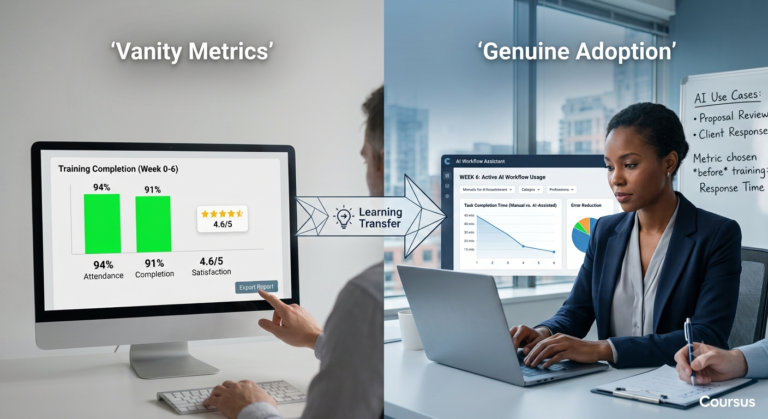
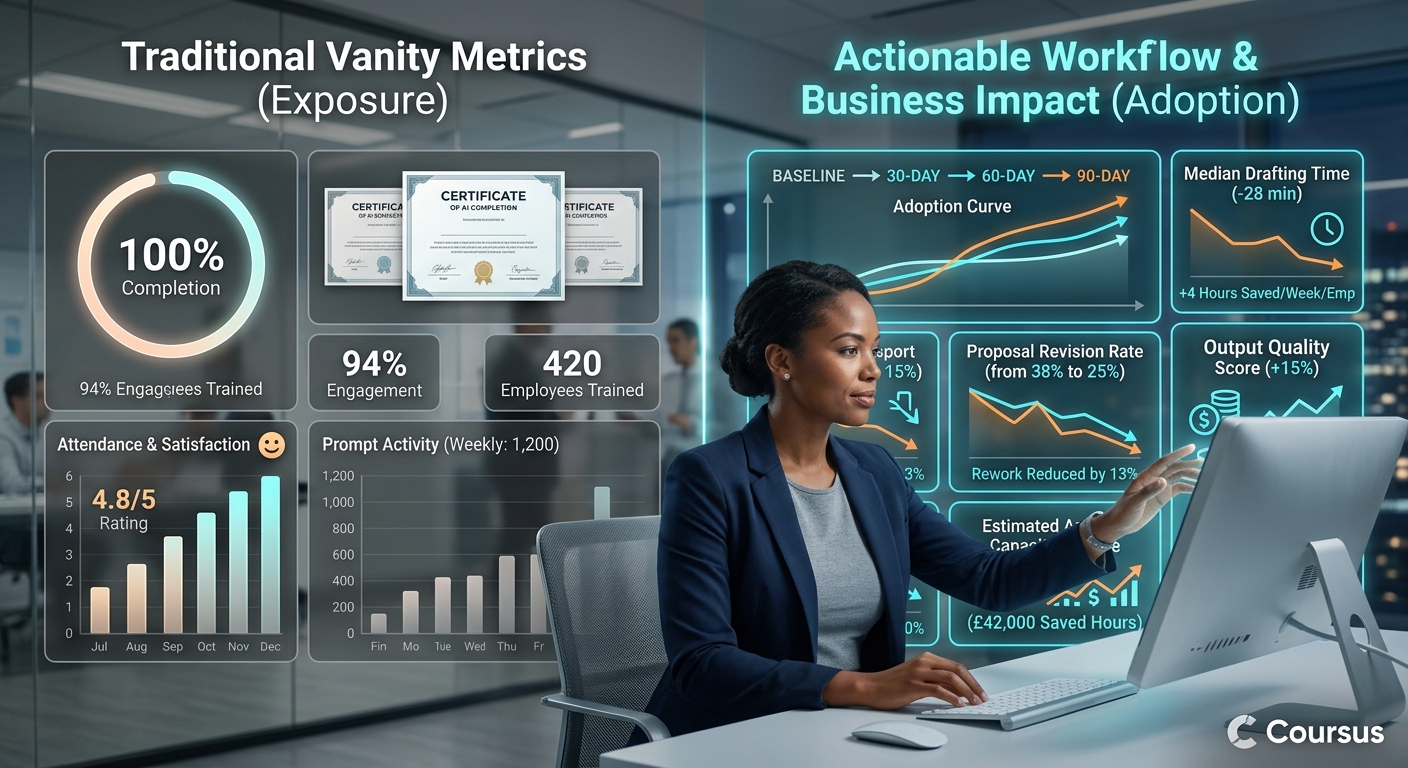

Somebody on your L&D team is about to put a slide in front of leadership. It says 94% completion and a 4.6-star rating. They’re going to call that proof the AI training worked.
It isn’t proof of anything. It’s proof that people sat in a room or logged into a call for a few hours.
Most companies measure AI training at the easiest point: attendance, completion or a satisfaction survey. Those figures show whether people showed up. They do not show whether anyone changed how they work.
To measure AI training effectiveness, a company needs a comparison, not a certificate. Define the workflow and the business outcome before training starts, record a baseline, deliver the programme, then measure the same workflow again under similar conditions.
This guide sets out what to measure before and after training, how to tell exposure apart from real adoption, how to connect workflow change to numbers a finance team recognises, and how to build a one-page measurement plan an HR or L&D team can run without a data science department.
Most companies measure AI training too early
Three kinds of results come out of any AI training programme: participation, capability and organisational value. Participation shows that people attended or logged in. Capability shows that people can demonstrate a skill. Organisational value shows that work changed and that the change mattered to the business.
Most measurement plans stop at the first output and call it proof.
A credible claim that AI training worked requires evidence across all three: a defined work process, an observable change in behaviour, and a measurable contribution to a business outcome. Kirkpatrick Partners separates evaluation into four levels — reaction, learning, behaviour and results — and treats results as the targeted organisational outcomes tied to an initiative, not learner sentiment about it (Kirkpatrick Partners).
Picture the evidence as a chain:
Training → Capability → Behaviour → Adoption → Operational change → Business outcome
A weak measurement plan jumps straight from “people attended” to “the training created value.” A credible plan checks each link before making the next claim.
The measurement test
If the training did not target a defined workflow, and nobody measured that workflow before and after delivery, the organisation cannot credibly claim the training worked.
Start with the work, not the classroom
“Improve AI literacy” is a fine programme goal. It is a weak measurement goal, because nobody can tell whether literacy improved without picking a specific task to watch. A stronger goal names a process directly: reduce the time it takes to produce a first-draft customer proposal without increasing errors.
Workflows worth measuring share five qualities. They happen often enough to generate data. They matter enough to justify attention. They connect directly to what the training covered. They stay stable enough to compare before and after. And a named owner can act on the result once it arrives.
- Don’t try to measure every department at once.
- Skip any metric chosen only because it’s easy to export.
- Tracking logins instead of completed work tells you activity happened, not that anything changed.
- Never change the process and the metric definition at the same time without recording it.
The Chartered Institute of Personnel and Development recommends linking evaluation to an identified performance gap rather than assessing learning in isolation (CIPD). Applied to AI training, that means naming the gap in the workflow before naming the course.
This is also where a workflow-first programme differs from a generic AI course. Training is built around the process a team already owns, not a list of AI tools the team might eventually try.
Establish the baseline before training begins
A baseline is the current value of the metric tied to the workflow the training is meant to change. It is not a general impression that “the team could use AI better.”
A useful baseline records eight things: the workflow, the exact metric definition, the current value, the data source, the population included, the measurement period, the conditions affecting the result, and the person responsible for measuring it again.
| Workflow objective | Baseline metric | Data source |
|---|---|---|
| Faster customer responses | Median minutes per response | CRM timestamps |
| Less document rework | Rework rate per document | QA records, version history |
| Better first-draft quality | Quality score against a rubric | Manager or reviewer scoring |
| Shorter reporting cycle | Hours per reporting cycle | Time study, workflow log |
| Fewer errors | Error rate per output | QA, audit or incident records |
Collect enough data to smooth out unusual days, without delaying the whole programme while chasing a perfect dataset. For a frequent workflow, two to four weeks is a reasonable starting point, though the right window depends on how much natural variation the workflow has. For a low-volume workflow, use a longer historical window or a structured sample instead.
Four terms get confused often enough to weaken a final report. A baseline is a measurement. Benchmarks are comparison points borrowed from elsewhere. Targets are the performance level the organisation wants to reach. And claims are what the organisation says caused the change.
Treating these as interchangeable produces reports nobody can defend in front of finance.
One-page baseline template (illustrative example)
| Field | Example |
|---|---|
| Business objective | Reduce rework in sales proposals |
| Workflow | First draft of standard proposal |
| Trained population | Twenty-four account executives |
| Baseline period | Four weeks before training |
| Metric | Percentage of proposals requiring major revision |
| Baseline value | 38% |
| Target | 25% or lower |
| Re-measurement dates | Day 30, Day 60, Day 90 |
| Owner | Sales enablement lead |
Measure four things, not one
| Metric type | Examples | Use |
|---|---|---|
| Activity | Attendance, completion, time in course | Delivery monitoring |
| Learning | Pre and post assessment, practical task | Capability evidence |
| Outcome | Task time, rework, quality, cost, revenue | Business impact |
Kirkpatrick’s four levels give a simple structure for AI training specifically. Reaction shows whether the training felt relevant to real work. Learning shows whether a skill was acquired, ideally through a practical task rather than a quiz alone. Behaviour shows whether people apply that skill weekly, without being told to. Results show whether an operational number moved, such as task time, error rate, rework or cost.
Treat tool logins and prompt counts with caution. They show exposure, not proof of safe or productive use. A learner can explain a prompting principle in a workshop and still fail to apply it under a real deadline.
Test the same workflow before and after training
The strongest before-and-after comparison keeps every variable stable except the training itself. That means the same workflow, the same metric definition, the same quality rubric, the same data source, the same population where possible, and a comparable measurement period.
Consider a proposal-drafting example. Before training, the median drafting time was 165 minutes, the major-revision rate was 38%, and the sample covered ninety-six proposals.
Before training
165 min
median drafting time
38%
major-revision rate
After training
118 min
median drafting time
31%
major-revision rate
Measured against the same rubric and the same proposal category, that pattern suggests improvement. It does not prove training caused every point of the change, and the article should say so rather than let the reader assume causation.
Report both the absolute change and the percentage change relative to the baseline. State clearly which direction counts as improvement for each metric.
Do not confuse AI usage with AI adoption
Exposure, adoption and impact are three different things, and treating them as one produces misleading reports.
Exposure means someone attended training, activated a tool, or logged into a platform. Adoption means someone applies AI inside a defined target workflow on a repeated basis, ideally confirmed by a manager. Impact means a business number actually moved: faster completion, fewer errors, less rework, or lower cost.
A team can look highly engaged on paper while producing no measurable value — exactly the gap explored in what AI high performers do differently, where the difference between activity and outcome is the whole argument.
| Stage | Measure | Timing |
|---|---|---|
| Exposure | Attendance and completion | During training |
| Early adoption | First use of target workflow | Days 7 to 30 |
| Sustained adoption | Weekly workflow application | Days 30 to 90 |
| Operational impact | Time, quality, cost or volume | Days 60 to 180 |
Prove the training caused the improvement
A simple before-and-after comparison can be pulled off course by factors that have nothing to do with training: seasonality, new software, a process redesign, staff turnover, demand swings, or a wider AI rollout happening at the same time.
Training Industry identifies comparison groups and other isolation methods as essential when leaders want credible evidence of impact rather than a coincidence (Training Industry).
Three designs improve confidence without requiring a statistics team. A comparison group trains one team first and measures a similar, untrained team alongside it. A staggered rollout trains teams in waves, so later teams temporarily serve as a comparison. A success-case review looks closely at the strongest and weakest individual results and asks what was different about each.
Attribution strength by method
| Method | Confidence |
|---|---|
| Simple before and after, no comparison | Low |
| Comparison group, no randomisation | Medium |
| Staggered rollout with a genuine control period | High |
Choose language that matches the design. “The trained cohort improved more than the comparison cohort” is defensible. “Training generated one million naira in savings” is not defensible unless the assumptions behind it are shown in full.
Turn workflow improvement into business value
Do not open with a savings figure unless the calculation has a transparent basis. Start with the operational change, then translate it.
Estimated annual capacity value = hours saved per task × tasks per period × periods per year × loaded hourly cost
If a team cuts a recurring task by thirty minutes, repeats it two hundred times a month, and the loaded hourly cost is thirty-five pounds, the estimated annual capacity value works out to roughly forty-two thousand pounds.
That is capacity released, not automatically cash saved. Saved time often supports more output rather than a smaller payroll — a distinction worth checking before a figure like that goes anywhere near a board pack, and exactly what stalls in an AI investment that isn’t changing how people work.
Up to 4 hrs/week
average time saving per employee that Airbus reported after an AI-upskilling programme. Treat this as one documented example, not a guaranteed outcome for every organisation. Source: UK Government case study collection, 2026.
A structured AI productivity audit is the natural next step once a workflow shows measurable time savings, because it traces where those recovered hours actually go inside the business — the exact process walked through in The AI Productivity Audit.
Time is only one value category. Quality shows up as a lower error or rework rate. Cost shows up as fewer external hours or lower processing costs. Revenue shows up as faster conversion or deal velocity. Risk shows up as fewer incidents or policy violations.
A full financial ROI calculation, following the Phillips methodology, only makes sense once these operational numbers are in hand.
Build a one-page AI training measurement plan
| Question | Decision |
|---|---|
| What workflow should change? | Name the exact process |
| What is the baseline? | Current value and measurement period |
| What quality or safety guardrail applies? | The non-negotiable standard |
| Who owns the data? | One accountable owner |
| When will it be measured? | Pre-training, Day 30, Day 60, Day 90 |
| How will value be translated? | Time, cost, quality, revenue or risk |
A first programme works best with a narrow scope: one workflow, one primary business metric, one quality or safety metric, one learning measure, one adoption measure, one baseline period, three follow-up points, and one named business owner.
That is more credible than a dashboard carrying thirty disconnected numbers nobody reviews after month one.
Build training around measurable adoption
Coursus Corporate AI Training starts with the work a team needs to improve, not a catalogue of AI tools. The programme connects role-specific learning to real workflows, responsible use, adoption support and measurable business outcomes. Visit coursus.io/corporate-ai-training to see the full curriculum and next intake dates.
Frequently asked questions
How do you measure AI training effectiveness?
Measure it across four layers: reaction, learning, workplace behaviour and business results. Define the workflow and the business outcome before training starts. Capture a baseline, then measure the same workflow using the same definitions once the programme finishes.
What is the best metric for AI training ROI?
There is no single best metric. Choose the one connected to the workflow the training is designed to change, such as task time, error rate, rework, output quality or cost. A credible ROI figure needs a baseline, transparent assumptions, full programme costs and an attempt to isolate the training’s contribution.
How long after AI training should effectiveness be measured?
Measure learning immediately after the programme, then check application and adoption again at roughly thirty, sixty and ninety days. Business outcomes may need ninety to one hundred and eighty days, depending on how often the workflow runs and how long the business cycle is.
Can completion rates prove that AI training worked?
No. Completion rates show participation, not workplace application or business value. Keep them as a delivery and engagement indicator, and pair them with a practical assessment, adoption evidence, and workflow-level outcomes before drawing any conclusion.
How do you create a baseline for AI training?
Choose a target workflow and record its current performance before training starts. Track factors such as task completion time, error rate, rework, output quality or tool usage. Record the data source, measurement period, population and metric definition so the same test can be repeated afterwards.
How can you prove that training caused the improvement?
Use a comparison group, a staggered rollout, or another isolation method wherever it is practical. At minimum, document any other change that could explain the result. Present training as a measured contributor unless the evaluation design genuinely supports a stronger causal claim.
How should companies in Nigeria and Ghana measure AI training impact?
The same principles apply, adjusted for local conditions such as connectivity, data costs, tool availability and sector-specific regulation. Start with operational measures the organisation already owns, such as turnaround time, rework, customer response time or transaction errors, rather than importing a benchmark built for a different market. Coursus adapts corporate AI training to specific roles, systems and operating environments across African and global markets alike.
The question is not whether employees attended
AI training worked only when it produced evidence of changed capability, changed behaviour and improved work. The measurement plan has to start before delivery, use a baseline that means something, repeat the same test afterwards, and translate credible improvement into value the business already understands.
Coursus.io Corporate AI Training
Not sure if your team is actually applying AI effectively or just relying on vanity metrics? Take our quick, free AI Maturity Quiz to evaluate your team’s current workflow adoption and identify critical training gaps before you invest.
Coursus Corporate AI Training starts with the work a team needs to improve, not a catalogue of AI tools, through the Coursus Method: Assess, Train, Apply, Measure. The programme connects role-specific learning to real workflows, responsible use, adoption support, and measurable business outcomes. Coursus has already delivered this training for teams across the UK, Africa, and beyond.
Coursus.io Editorial—practitioner-grade AI education for professionals across Africa and beyond. Every article is reviewed by subject-matter experts before publication.