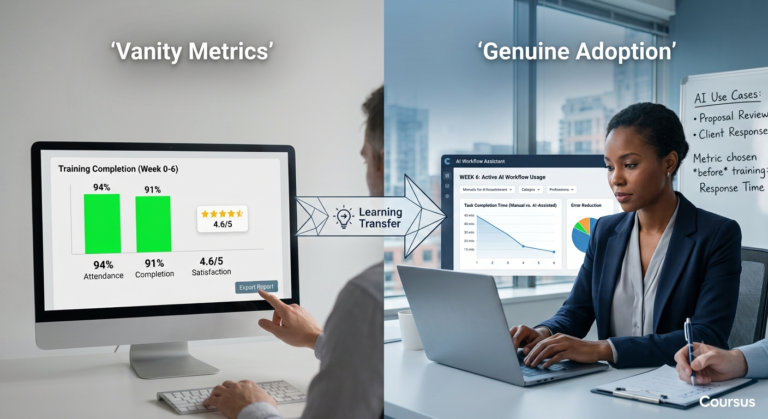


Somewhere in your building right now, someone is finishing in twenty minutes a report that used to take two hours. Ask them how it’s going, and they’ll tell you AI has changed everything. Ask your CFO the same question, and you’ll get a different answer because that twenty-minute report still waits nine days for the same three approvals it always did, and nothing on the P&L has moved.
Both of them are right. That gap between the two answers is where most AI investment quietly goes to die, AI investment results is not always easy to see and it’s the subject of this article.
The evidence for the gap is unusually consistent. McKinsey’s 2026 global survey of 1,719 respondents across 97 countries found that 80% say AI has improved their individual productivity and about half say it helps them make better decisions. Yet only 37% report that AI has contributed positively to their organisation’s EBIT, essentially unchanged from the previous year. Just 6% qualify as AI high performers.
That gap is not proof that AI lacks value. It is evidence that personal time savings do not convert into enterprise results on their own. Something has to change in between, and in most organisations nothing has.
This article gives you seven checks to run before you approve further spending. By the end you will be able to tell whether your problem is a weak business case, an unchanged workflow, low-quality use, poor data conditions, missing role capability, weak management reinforcement, or a measurement system that cannot see business outcomes at all.
KEY DISTINCTION AI adoption means people use the tool. AI transformation means the organisation has changed how important work is designed, performed, reviewed, measured and managed. The first is visible in a dashboard within weeks. The second is visible in operating results, and only if someone deliberately built it.
Why AI investment is not delivering results in most organisations
The most common failure pattern is simple: the tool was added to the old process. Employees now draft faster, summarise faster and search faster, but the approvals, handoffs, queues and quality checks that surround those tasks are untouched. The process absorbs the savings before it reaches the business.
Independent evidence points the same way. An NBER working paper surveying nearly 6,000 senior executives in the United States, the United Kingdom, Germany and Australia found that more than 90% reported no effect of AI on their own firm’s employment over the previous three years, and 89% reported no impact on labour productivity measured as sales per employee. Around 70% of those firms were actively using AI.
Read that carefully, because the wording matters. It does not show that AI produces no benefit. The same paper finds a small average productivity effect concentrated in a minority of firms and executives expecting considerably larger gains ahead. What it shows is that most firms had not yet detected a measurable firm-level effect. Task-level gains can be entirely real while enterprise productivity stays flat.
It is useful to separate four levels, because organisations routinely mistake one for another.
| Level | What is happening | Typical evidence |
|---|---|---|
| Access | Employees are allowed to use AI | Licences, permissions, approved tool list |
| Activity | Employees are using AI | Logins, prompts, active users, session counts |
| Changed work | AI has changed a recurring workflow | Fewer handoffs, redesigned roles, new decision points |
| Business impact | The organisation performs better | Lower cost, better quality, faster service, more revenue, less risk |
Access and activity are necessary. Neither is sufficient. The diagnostic question for the next board meeting is not how many people use AI. It is this: what important work is now performed differently because of AI? If the room cannot name a specific workflow, you have an adoption programme, not a transformation.
Check one: was the business case written as an outcome?
Start with the paperwork, because a surprising number of AI investments were never defined in terms a finance team could test. Ask what business outcome the investment was supposed to improve and whether that outcome was cost, quality, speed, revenue, customer satisfaction, risk or released capacity. Then ask whether anyone recorded a baseline before deployment.
Bain’s 2026 research on 951 companies with revenues above $100 million found a consistent shortfall between targeted and realised savings: 37% had targeted cost reductions in the 11–20% range, while the largest group of those measuring outcomes landed at 10% or below. Bain’s warning to CFOs is the part worth repeating internally, which is that the next wave of investment is frequently sized against the projected savings of the last wave rather than the actual ones, which Bain calls “a circular bet with a structural leak”.
There is a second, subtler failure. Many business cases assumed a level of autonomy that production never delivered. Bain found only 7% of companies running fully autonomous agents, while the most common configuration still requires human approval. A case built on end-to-end automation will underdeliver by design when the deployed system is an assisted workflow with a reviewer attached.
| Weak business case | Strong business case |
|---|---|
| “Deploy an AI assistant across the company” | “Cut first-draft preparation time in legal operations by 25% with no drop in quality.” |
| Tool-led | Outcome-led |
| No baseline | Baseline measured before deployment |
| Benefits assumed from demonstrations | Benefits tested under production conditions |
| No accountable owner | Named business owner, not an IT owner |
| Activity reported | Business outcome reported |
| Assumes full autonomy | States exactly where a human reviews and decides |
If your case fails four or more of these rows, more budget will not fix it. Rewrite the case before you renew anything.
Check two: were the workflows redesigned, or just accelerated?
This is the single highest-yield check, and it is also where the evidence is the sharpest. McKinsey found that nearly three-quarters of AI high performers report fundamentally redesigning workflows because of AI, this is up from just over half a year earlier, when compared with roughly a quarter of everyone else. High performers were also about twice as likely to say senior leaders demonstrate genuine ownership of AI initiatives.
Bain calls the underlying problem workflow debt: the accumulated cost of unnecessary handoffs, duplicate approvals, spreadsheet workarounds, fragmented systems and outdated process assumptions that build up around work over time. Their argument is straightforward: automating a broken process does not resolve the underlying problems. It locks them in, speeds them up, and makes them considerably more expensive to unwind later.
So stop discussing AI in the abstract and map one complete workflow end to end. Document the trigger, the inputs, the systems touched, the people involved, the decisions made, every handoff and approval, where AI is involved, what review is required, and the outcome. Then interrogate the map:
- Which steps disappeared entirely?
- Which steps became faster, and by how much?
- Which steps became more complex because AI output now needs verifying?
- Where exactly does human review happen, and who owns the final decision?
- Did the change create a new queue? For example, a reviewer bottleneck that did not exist before?
- Did AI simply shift work from producing to checking?
A useful sanity test: if you removed the AI tool tomorrow, how long would it take the team to return to the old way of working? If the answer is “about an hour”, nothing has been redesigned. You have layered a tool onto a process that was never revisited.
Check three: is AI being applied to work that actually matters?
Usage volume is a weak signal because it treats all use as equivalent. A marketing team generating drafts all day and a claims team restructuring how exceptions get handled will look similar in a licence report and completely different in the accounts.
Quality is the other half of this check, and the picture is sobering. SHRM’s 2026 research, based on 5,875 US-based workers, found that 41% use AI at work, and 44% of those users say their own output includes “AI slop.” Notably, seniority made this worse rather than better: directors and above used AI more and were more likely to report producing lower-quality output.
Two things follow. First, usage and poor quality coexist comfortably, so high adoption figures prove very little on their own. Second, an organisation that treats any use as good use will accumulate exactly the kind of plausible, polished, subtly wrong output that costs more downstream than it saved upstream.
AMBER — WHAT TO DO WITH THIS Segment your usage data by role, workflow, task type, frequency and review outcome before you report it. A single number showing that 68% of staff used AI last month is not a finding. It is a rounding of several very different situations into one reassuring figure.
Use a four-stage model instead of a headline number:
| Stage | Question | Example metric |
|---|---|---|
| Availability | Can the person access the tool? | Licence activation rate |
| Activity | Is the person using it? | Active users, sessions |
| Capability | Can the person use it appropriately? | Verification and quality assessment scores |
| Value | Does the use improve work? | Cycle time, error rate, revenue, risk, customer outcome |
Check four: do your data and systems support the use case?
Bain’s 2026 survey identified data access and integration as the leading barrier to AI progress cited by 41% of respondents, above budget, skills and executive buy-in. This is rarely what executives expect, because data modernisation has already absorbed enormous investment at most large organisations.
Work through the conditions honestly:
- Is the information the workflow needs actually accessible to the people and systems doing the work?
- Is it current, and is it reliable enough to act on without a manual check?
- Is it structured, or does it live in PDFs, email threads and someone’s spreadsheet?
- Can the AI system reach the systems of record, or are employees copying data between tools by hand?
- Are permissions blocking legitimate work, or permitting work that should be blocked?
- Are multiple versions of the truth circulating between departments?
One caution: this check is easily misused. Imperfect data is not a reason to stop all AI work, and treating it as one produces indefinite deferral. Bain’s recommendation is the opposite: use AI to help solve the data problem rather than waiting for the data problem to be solved first. Begin where data is already bounded and accessible and where the outcome is measurable, then let early wins fund the wider modernisation conversation.

Check five: have roles, managers and incentives changed?
AI changes what a job consists of long before it changes what a job is called. People move from drafting to reviewing, from searching to evaluating, from processing to exception handling, from producing outputs to exercising judgement. Very often, nothing in the role description, the training, the targets or the performance conversation reflects that shift.
Gallup’s 2026 survey of US workers in organisations that had implemented AI found that only 12% strongly agreed that AI had transformed how work gets done. The same research found the strongest predictor was not technical integration but the direct manager: employees whose managers actively supported AI use were 8.7 times more likely to say their work had been transformed and fewer than one in three strongly agreed that their manager actually does so.
A Workday-commissioned global study, conducted by Hanover Research, adds a structural finding that explains a great deal: nearly nine in ten organisations said fewer than half of their roles had been updated to include AI-related skills. The tool arrived. The job description did not move.
So ask the uncomfortable questions. Has the role description changed? Have performance expectations changed? Do managers understand the new workflow well enough to coach it? Is the employee rewarded for speed, volume, quality or judgement, and also, does the organisation quietly penalise the person who takes an extra twenty minutes to verify an output properly? Are people worried that admitting to AI use will count against them at review time?
This is where role-specific AI training built around real workflows does work that generic awareness training cannot. A course completion proves attendance. It does not prove that a finance analyst knows which reconciliation steps are safe to delegate, what a good verification looks like, or when to escalate.
Check six: does the organisation measure outcomes or activity?
Most AI reporting measures the easiest thing to collect. Prompts, logins and licence utilisation are available on day one; cycle time, first-pass acceptance and cost per case require somebody to go and build them.
The consequences show up in the research. KPMG’s Q2 2026 Global AI Pulse, surveying more than 2,000 leaders across 20 countries, found that only 24% of organisations name the CEO or executive committee as accountable for AI-informed decisions. Where they do, the difference is stark: those organisations report higher confidence in their AI strategy (60% versus 22%), are far more likely to realise meaningful business value (57% versus 21%), and are nearly four times more likely to report an established ROI (14% versus 4%).
Build a measurement ladder and make sure every rung has an owner:
| Level | Example metric |
|---|---|
| Adoption | Share of eligible employees using approved AI |
| Capability | Share who can verify and improve an AI output to standard |
| Behaviour | Share using AI inside an approved recurring workflow |
| Workflow | Average cycle time for the redesigned process |
| Output | Error rate, rework rate, first-pass acceptance |
| Business outcome | Cost per case, retention, revenue contribution, risk events avoided |
KEEP THIS IN THE BOARD PACK A dashboard showing more prompts proves that people are active. It cannot prove that the organisation is more productive. Activity is an input measure wearing the costume of a result.
Resist the urge to measure everything. Pick one primary business outcome, two supporting operational measures, one quality or risk guardrail, and one people measure wherever the workflow changes what employees are responsible for.
Check seven: is capability role-specific or generic?
Training is the check most often assumed to be complete. Everyone attended the session; the LMS shows 94% completion; the box is ticked. But a completed course does not demonstrate that an employee can identify a suitable use case, choose the right tool, supply adequate context, verify the output against a source, handle confidential information correctly, integrate the tool into a recurring workflow, or explain what improved as a result.
The honest standard is this: AI training should be evaluated by changed work, not by attendance or completion. If the curriculum cannot name the specific tasks it is meant to change, it cannot be assessed, and it will not survive contact with a real process.
Connect capability directly to the workflow question by asking, for each redesigned process:
- Which roles use AI in this workflow?
- On which specific tasks, at which stage?
- With what quality standard and what risk controls?
- What new human judgement is now required that was not required before?
- How will the line manager know whether the change helped?
If those five questions have answers, you have a capability plan. If they do not, you have a training budget.
A 30-day AI investment diagnostic
Run this before approving any further spend. It needs one accountable executive, access to two workflows, and roughly a day a week of a capable analyst’s time.
Days 1–5: define the problem. Identify the investment and the outcome it was supposed to improve. Name the accountable business owner. Retrieve the original assumptions, including any assumed level of autonomy. Establish or reconstruct the baseline. Select one or two workflows that genuinely matter.
Days 6–12: observe the actual work. Interview the employees and their managers. Watch the workflow being performed rather than reading the documented version. Record rework, handoffs, delays and approval queues. Identify precisely where AI helps and where it quietly adds work.
Days 13–19: assess capability and risk. Review what role-specific training actually exists. Test a sample of outputs for quality. Check data access and permissions. Identify privacy, security and compliance exposure. Establish whether employees understand who is responsible for verification.
Days 20–30: redesign and measure. Redesign the workflow, removing unnecessary steps before adding anything. Set a small number of outcome metrics with named owners. Run a controlled pilot against the baseline. Then decide deliberately: scale, redesign again, or stop.
START WITH CAPABILITY, NOT MORE LICENCES Coursus Corporate AI Training builds role-specific AI capability around the workflows your teams actually run, with responsible-use standards and measurable outcomes built into the programme rather than bolted on afterwards. Programmes are delivered for teams of 5 to 100+ across Lagos, Nairobi, Accra and London. Visit the executive AI capability programme page at coursus.io to see the curriculum and current intake dates.
Frequently asked questions
Why is my AI investment not improving productivity?
Usually because the tool was added to an unchanged process. Individual time savings are real but get absorbed by review, rework, approvals and unchanged handoffs before they reach the business. McKinsey’s 2026 survey shows the pattern clearly: 80% of respondents report improved personal productivity, while only 37% report any positive EBIT contribution. The differentiator among high performers is workflow redesign, senior leadership ownership and defined processes for measuring impact and not a tool selection or budget size.
How can a company tell whether AI is actually changing work?
Ask one question and demand a specific answer: which recurring workflow is now performed differently, and what changed about it? A genuine answer names steps that disappeared, handoffs that were removed, decisions that moved, and a metric that moved with them. If the answer is a usage statistic, a licence count or a training completion rate, the work has not changed. A second useful test is how quickly the team could revert to the old process if the tool were removed tomorrow.
Are AI usage metrics useful for measuring adoption?
They are useful but insufficient. Logins, prompts and active-user counts tell you whether access converted into activity, which is worth knowing early in a rollout. They cannot tell you whether the use was appropriate, whether the output was accurate, whether it was accepted downstream, or whether anything improved. Treat usage as a leading indicator that should be retired from executive reporting once the programme moves past its first quarter, and replaced with workflow and outcome measures.
What should leaders measure after deploying AI tools?
Use a ladder: adoption, capability, behaviour, workflow, output and business outcome. Then pick a small set such as one primary business outcome, two operational measures such as cycle time and rework rate, one quality or risk guardrail, and one people measure where roles have changed. Every metric needs a named owner and a pre-deployment baseline. KPMG’s Q2 2026 research found only 24% of organisations have clear CEO-level accountability for AI-informed decisions, and those that do report established ROI nearly four times as often as those that do not.
Should we buy more AI tools if the first investment has not delivered?
Not until you have run a diagnostic on the first one. Bain’s 2026 research found that 44% of companies were funding their next wave of AI investment from savings that had not yet materialised from the previous wave. Additional budget does not correct an unvalidated investment case, an unchanged workflow or a missing owner instead, it multiplies them. Fix the business case, redesign one workflow, prove the outcome against a baseline, and let that result size the next investment.
How should Nigerian and African organisations approach AI investment when infrastructure and data quality vary?
Start where conditions are already adequate rather than waiting for them to be uniform. The IMF’s 2026 paper on AI in Sub-Saharan Africa estimates that under current conditions the region gains roughly 0.2% in productivity over a decade. That figure rises to about 2.1% only under a separate, higher-adoption scenario in which electricity, connectivity, skills and governance gaps are substantially closed, the two numbers describe different futures, not a guaranteed range. Practically, that means choosing bounded workflows where the data is accessible and the outcome is measurable, budgeting for power and connectivity resilience as part of the programme rather than as an afterthought, and investing in role-specific capability, which is the one input an organisation controls entirely regardless of national infrastructure.
THE NEXT STEP IS CAPABILITY, NOT PROCUREMENT AI investment produces value only when people can apply it to the right work, inside a workflow that has been redesigned to let the saving through. Coursus builds role-specific AI capability around real workflows, responsible use and measurable outcomes for depatments like finance, HR, sales, legal, marketing and operations teams. Visit Coursus Corporate AI Training to see the full curriculum, delivery options and next available intake.