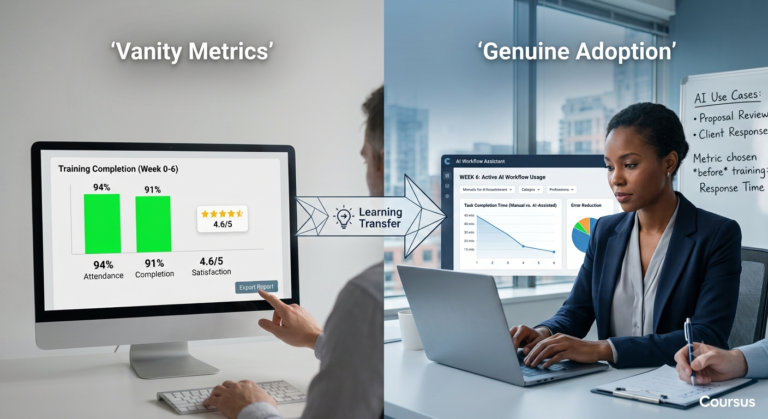


Corporate AI training often fails after the course ends, not because employees cannot learn the tools, but because their work environment still rewards the old workflow.
The real test comes later.
Can employees still use AI safely and effectively when the trainer has left, the launch campaign is over, and the next deadline has arrived?
That is where many AI training programmes run into trouble. A team can complete every module, give the trainer excellent feedback, and experiment with an AI tool during a workshop, then return to its previous way of working the next morning. This is exactly how corporate firms lost not less than $400 billion on training and learning investments
Completion proves exposure. It does not prove adoption.
The difference matters because AI training is ultimately supposed to change how work gets done. If the workflow, management expectations, practice opportunities and measurement system remain unchanged, employees have little reason to abandon a familiar process simply because they attended a new course.
This is why the question should not be: Did employees learn AI? It should be: Did the way they work change, and did that change survive after the training ended?
The real gap is adoption versus reversion
There are several different things that can happen after an employee receives AI training.
| Stage | What it means |
|---|---|
| Learning | The person understands a capability or technique. |
| Exposure | The person attended training or tried the tool. |
| Adoption | The person repeatedly uses the capability in a relevant workflow. |
| Reversion | The person returns to the previous workflow when support or attention fades. |
| Value | The changed workflow improves a defined outcome without creating unacceptable risk. |
These stages are not interchangeable. Someone can understand how to use an AI tool without using it at work. They can use it once without making it part of a workflow. They can adopt it temporarily and then stop.
That last stage is particularly important. Reversion is often treated as evidence that employees are resistant to change. In many cases, it is a perfectly rational response to the environment around them.
If the new process is unclear, slower, risky, unsupported or incompatible with existing performance expectations, the old process may simply be easier.
The distinction is important because it changes where the organisation looks for the problem. Instead of asking, “Why aren’t our employees using the training?”, ask: What makes the old workflow easier to return to?
What the research says
McKinsey’s 2025 workplace research found that employees saw formal generative AI training and integration into existing workflows among the organisational measures most likely to increase their use of AI. The finding is useful because it puts training and workflow integration together rather than treating training as a standalone intervention. Source: McKinsey, Superagency in the Workplace, 2025.
Learning AI is not the same as changing how work gets done.
Why completing training does not prove behaviour changed
Training evaluations often stop at the easiest things to count. How many people attended? How many completed the course? Did they like the session? Did their confidence increase?
Those measures are useful. They tell you whether people were exposed to the programme and whether the learning experience itself was acceptable. They do not tell you whether the organisation changed.
| What the organisation measures | What it may actually show |
|---|---|
| Course completion | The learner attended or finished the programme |
| Satisfaction | The session was acceptable or enjoyable |
| Confidence | The learner feels more capable |
| Prompt-writing activity | The learner experimented |
| Tool logins | The tool was opened |
| Repeated use in a defined workflow | Behaviour may be changing |
| Time, quality, error or rework movement | The workflow may be producing value |
The progression matters. A login is not adoption. A prompt is not productivity. Confidence is not proficiency. And course completion is not business impact.
The stronger question is whether the employee is repeatedly using the capability in the specific workflow the organisation intended to improve.
38%
of AI adoption challenges stem from user proficiency issues, the largest single barrier between deployment activity and actual adoption. Traditional metrics such as licences, logins and training completion show access, not proficiency. Source: Prosci, 2026.
That is also why measurement needs to be connected to the work itself. Prosci’s current enterprise AI adoption guidance distinguishes deployment, adoption and proficiency, and recommends connecting adoption measures to outcomes such as productivity, error reduction and employee-reported time savings.
The closer measurement gets to the actual workflow, the more useful it becomes.
Six reasons corporate AI training does not stick
1. The training teaches features instead of work
One of the easiest ways to design an AI course is to follow the product interface: how to write a prompt, how to summarise a document, how to generate an email, how to use a particular feature.
There is nothing inherently wrong with teaching these capabilities. The problem comes when the training ends there. The employee returns to a workflow containing the same handoffs, approval rules, quality standards, data restrictions and deadlines. If AI simply adds another step, the old method may remain easier.
A workflow-first approach starts somewhere else: identify a repeated, costly or error-prone task, map how the task currently moves, identify where AI can assist, define where human judgement remains mandatory, and change the procedure and ownership where necessary. Then train people on that redesigned workflow.
This is a very different proposition from teaching people a collection of AI features and asking them to work out where those features might fit. McKinsey’s research makes a similar point: putting technology into people’s hands does not automatically change the way a company works. The organisation has to identify suitable workstreams and integrate AI into them.
2. The examples do not match the employee’s role
Generic AI training creates another problem. The same examples do not carry equal value across departments. A salesperson may care about account research, call preparation, CRM updates and proposal drafting. A procurement professional may care about supplier comparison, RFP preparation, contract documents and negotiation preparation. An operations team may care about reporting, forecasting, exception handling and incident analysis.
The underlying AI capabilities may overlap. The workflows do not. That distinction matters because employees need to recognise the connection between what they learned and what they are expected to do tomorrow.
Role-specific use cases reduce that distance. They also make measurement easier: instead of asking whether a department is “using AI,” the organisation can ask whether a particular workflow has changed. That is a much more useful question.
3. Managers receive no adoption playbook
Training can tell employees what to do. Managers help determine whether the behaviour survives. If a manager never asks how AI was used, never models responsible use, continues rewarding only the old output metric or discourages experimentation whenever work becomes busy, employees receive a clear signal.
The signal is not necessarily “AI is forbidden.” It may simply be: this is optional, and the old way is still what matters.
That is why managers do not need to become AI engineers. They need enough understanding to reinforce useful and responsible application. A manager can ask which workflow the employee tried to improve, what changed, what went wrong, where human review remained necessary, what would make the safe path easier, and what should be measured next. Those questions turn AI training from an isolated learning event into an ongoing conversation about work.
51%
of managers expect AI training or upskilling to become a key part of their own responsibilities within five years, and 35% are considering hiring dedicated AI trainers in the next 12–18 months. Source: Microsoft Work Trend Index, 2025.
The direction is significant. As AI becomes embedded in everyday work, the manager increasingly sits between formal training and practical adoption.
4. Employees have no protected practice time
There is another reason people revert. They are busy. It is easy to tell employees to experiment with a new AI workflow. It is much harder to ask them to experiment while a client is waiting, a customer complaint needs answering or a board report is due in two hours. Under pressure, people usually return to the method they already trust.
That is why protected practice matters. It does not require a permanent training calendar. It can be a short, structured opportunity to work on a real or safely anonymised task, test one defined use case, compare AI output with the existing method, identify errors, practise the required review step, and discuss what should and should not be delegated to AI.
The purpose is to lower the cost of the first few attempts. Employees should not have to discover whether a new method works for them for the first time on high-stakes live work.
5. The workflow itself has not changed
This is one of the biggest reasons AI training gets blamed for an organisational problem. Imagine an employee is trained to use AI to prepare a weekly report. The old process is to gather information from three systems, copy it into a spreadsheet, write the report, send it to a manager, have the manager review it, make corrections, and distribute the final version.
The employee now knows how AI could help with the writing step. But the other steps remain. Perhaps the AI output also needs to be copied manually into the existing template. Perhaps the manager has not agreed to the new process. Perhaps the employee is still measured against the old turnaround target. Perhaps nobody has defined what information can safely be entered into the AI system.
The employee has not failed to adopt AI. The workflow was never redesigned for AI. Before training, organisations should therefore ask where exactly the new capability enters the process, which old step disappears or changes, who owns the output, where human approval is required, what data can be used, and how quality will be checked.
Without those answers, training can leave employees with an additional task rather than a better way of working — the same pattern examined in our AI investment isn’t changing how people work, which walks through what to check when AI spend stalls at exactly this point.
6. Measurement ends when the session ends
This is perhaps the simplest failure to diagnose. The programme is measured immediately after delivery. The participants enjoyed it. The completion rate was high. The feedback was positive. The training is declared successful. But what happened afterwards?
Deployment → Participation → Usage → Behaviour → Proficiency → Outcome
Deployment asks whether the tools and infrastructure are available. Participation asks whether people attended. Usage asks whether they actually used the tools. Behaviour asks whether they repeatedly use AI in the target workflow. Proficiency asks whether they can use it effectively and safely. Outcome asks whether the changed workflow produced a measurable improvement.
The further down the ladder the organisation can measure, the more meaningful the evidence becomes. That does not make completion or satisfaction useless. They are leading indicators. They simply should not be mistaken for proof that the training changed the business.
The manager gap: who reinforces the new behaviour?
Imagine a team has completed general AI training but has not changed its reporting workflow. The manager chooses one weekly report that consumes significant time. The team tests one AI-supported version. The manager defines the human review step. The team compares the new process against the old one.
At the next team meeting, they discuss what happened. Not whether AI is exciting. Not whether everyone likes it. Whether the workflow improved.
The team might measure completion time, rework, factual or calculation errors, quality against the existing standard, employee friction, and the amount of human review required. If the new process creates more problems than it solves, they can change it or abandon it.
That is adoption work. It is also why responsible AI use cannot be separated entirely from AI training — including the baseline literacy requirements now written into regulation such as Article 4 of the EU AI Act. Employees need to know what they can use, which data they can handle, where human judgement remains necessary and what to do when an AI output is wrong.
The objective is not to force AI into every workflow. It is to make appropriate AI use easier to practise, review and improve.
What should happen after the training ends?
The post-training period does not need to follow one universal timetable. A complex workflow performed once a month may need a different support model from a simple task performed several times a day. But a practical embed model can look like this.
Week 1: Apply one defined use case
Participants try one workflow they understand. They record where AI helped, where it failed and where human judgement was required. The objective is application, not experimentation for its own sake.
Weeks 2–3: Remove friction
Managers and programme leads collect obstacles. Perhaps employees cannot access the approved tool. Perhaps the prompt template is poor. Perhaps the policy is unclear. Perhaps the workflow contains an unnecessary approval step. Perhaps the AI output is useful but the employee has no practical way to incorporate it into the existing process. Fix those problems. Do not automatically schedule another training session.
Week 4: Check for reversion
Now ask what people are actually doing. Are they still using the new workflow? Has usage become part of normal work? Are people quietly returning to the previous process? Self-reported enthusiasm is not enough here. The organisation needs evidence from the workflow itself.
Weeks 5–6: Re-measure and adjust
Compare the workflow against the original baseline. Keep strong use cases. Improve weak ones. Update job aids. Clarify review requirements. Remove unnecessary steps. Provide additional support where the evidence shows a genuine capability gap.
After that initial period, support can become more selective. Not every team needs weekly meetings indefinitely. The right level of reinforcement depends on workflow frequency, complexity, risk and how quickly the tools themselves are changing. The important point is that the training session is not treated as the finish line.
How to tell whether AI training is working
The most useful measures are connected to the workflow the programme was designed to change.
Exposure measures
These tell you whether people encountered the programme: attendance, completion, satisfaction, confidence. Useful, but limited.
Behaviour measures
These tell you whether something is changing: repeated use in target workflows, number of employees applying the method, frequency of workflow use, depth of use, manager-observed behaviour, and quality of human review.
Outcome measures
These tell you whether the changed workflow is producing a result: task completion time, error rate, rework, output quality, customer response time, time recovered and how it is redeployed, risk or compliance incidents, and employee-reported friction.
On that last point, be careful: time recovered is not automatically money saved, a distinction covered in more depth in The AI Productivity Audit.
The measurement principle is simple: measure the workflow the training was designed to change, not every possible AI activity in the organisation.
A marketing team does not need to prove that employees have used ten different AI features. It may need to prove that one defined content workflow became faster without reducing quality. A finance team does not necessarily need a dashboard showing every AI interaction. It may need to know whether a defined reporting process now takes less time, produces fewer errors or requires less rework. That is a much stronger connection between training and organisational value — the same discipline behind what AI high performers do differently when they convert usage into measurable value instead of activity metrics.
Knowing what to measure isn’t the same as building it in from day one
Every measure above depends on training that was designed around a real workflow in the first place, not bolted on afterwards. Coursus.io’s Corporate AI Training builds the baseline, the workflow redesign and the six-week re-measurement into the programme itself, through the Coursus Method — Assess, Train, Apply, Measure — rather than treating measurement as an afterthought. Visit coursus.io/corporate-ai-training to see how it’s structured.
A practical test for your next AI training programme
Before approving another corporate AI training programme, ask seven questions.
- Which workflow is this training meant to change? If the answer is simply “AI capability across the business,” the target may be too vague.
- What does that workflow currently cost? Measure what matters: time, quality, rework, errors, customer response or risk.
- What will employees do differently on the next working day? If there is no clear answer, the programme may be teaching awareness rather than application.
- Which examples match each role? People need to see how the capability connects to their actual work.
- What must managers reinforce? Define the conversations, review requirements and expectations that sit after the course.
- Where can employees practise safely? Give people a realistic opportunity to use the new method before expecting them to rely on it under pressure.
- When and how will the organisation re-measure the result? Decide this before the training starts.
If the answers concern mainly tools, features, attendance and satisfaction, the programme is probably measuring awareness. If the answers identify workflows, managers, safeguards, practice and outcomes, the organisation has a much stronger basis for measuring adoption.
Frequently asked questions
Why doesn’t AI training work in the workplace?
AI training often fails when it teaches tool capabilities without changing the workflow in which employees are expected to use them. Adoption can also weaken when managers do not reinforce the behaviour, employees lack protected practice time and nobody measures what changed after training. The problem is therefore not necessarily a lack of employee interest. The surrounding implementation system matters.
How do you make corporate AI training stick?
Design training around a small number of real workflows, use role-specific examples, provide protected practice, prepare managers to coach application and offer support after the main session. Establish a baseline before training and re-measure the same workflow afterwards. The aim is to make the safe and useful path easier to follow than simply returning to the old process.
What should companies measure after AI training?
Companies should measure repeated use in the target workflow, proficiency and review quality, alongside an outcome such as task time, errors, rework, quality or customer response time. Completion and satisfaction can remain useful leading indicators, but they should not be treated as proof of business impact.
How long does it take for AI training to become a habit?
There is no universal timetable. The appropriate review period depends on how often employees perform the workflow, how difficult the process is, how much manager support exists and whether the workflow itself has been redesigned. A 30- to 60-day review cycle can be a practical starting point, but organisations should measure actual behaviour rather than assume that a fixed number of days creates adoption.
Should managers be required to use AI?
Managers should understand the approved use cases, risks, review requirements and expectations relevant to their teams. They should model responsible experimentation and ask about workflow outcomes. A blanket requirement to use AI can create unsafe or performative behaviour where the technology is not appropriate for a particular task.
Does AI training work for Nigerian or African companies?
The underlying principle is the same: training is more likely to transfer when it reflects the workflows people actually perform and when the organisation measures what changes afterwards. The programme should also account for local operating conditions, including tool availability, connectivity, language and market context, data-handling requirements and licensing costs. For organisations operating across African markets, approved use and data boundaries should be particularly clear rather than left to individual employees to interpret.
Your AI training does not need to end when the trainer leaves
The problem with many corporate AI training programmes is not that the training session was necessarily poor. It is that the organisation expects the session to do a job it was never designed to do alone.
Training can build knowledge. It can build confidence. It can give employees a safe place to experiment. But sustained adoption depends on what happens around that training: the workflow has to make sense, the examples have to match the role, managers have to reinforce the behaviour, employees need opportunities to practise, responsible-use boundaries have to be clear, and someone has to measure whether the work actually changed.
Corporate AI training does not stick when the organisation measures whether people attended instead of whether work changed. The course may create initial capability. Adoption requires the system around that capability to support it.
Coursus.io Corporate AI Training
Not sure if your team is actually applying AI effectively or just relying on vanity metrics? Take our quick, free AI Maturity Quiz to evaluate your team’s current workflow adoption and identify critical training gaps before you invest.
If your organisation has already invested in AI training but cannot show what changed afterwards, start with the workflow and the baseline, then design the training around them. Coursus.io’s Corporate AI Training connects AI learning to real work through the Coursus Method, Assess, Train, Apply, Measure, using role-specific training, practical application, responsible use and post-training measurement rather than a one-off demonstration. Coursus has already delivered this training for teams across the UK, africa and beyond.
Coursus.io Editorial — practitioner-grade AI education for professionals across Africa and beyond. Every article is reviewed by subject-matter experts before publication.